In this article
A polite reply can feel like progress without answering the question that brought you to the program owner. “We received your message” confirms receipt. “Your expense was reviewed” describes an activity. Neither necessarily explains which condition was applied or what you need to do next. Closing an unresolved payout-purpose question means identifying the actual answer and any remaining action, rather than treating the end of a conversation as the end of the issue.
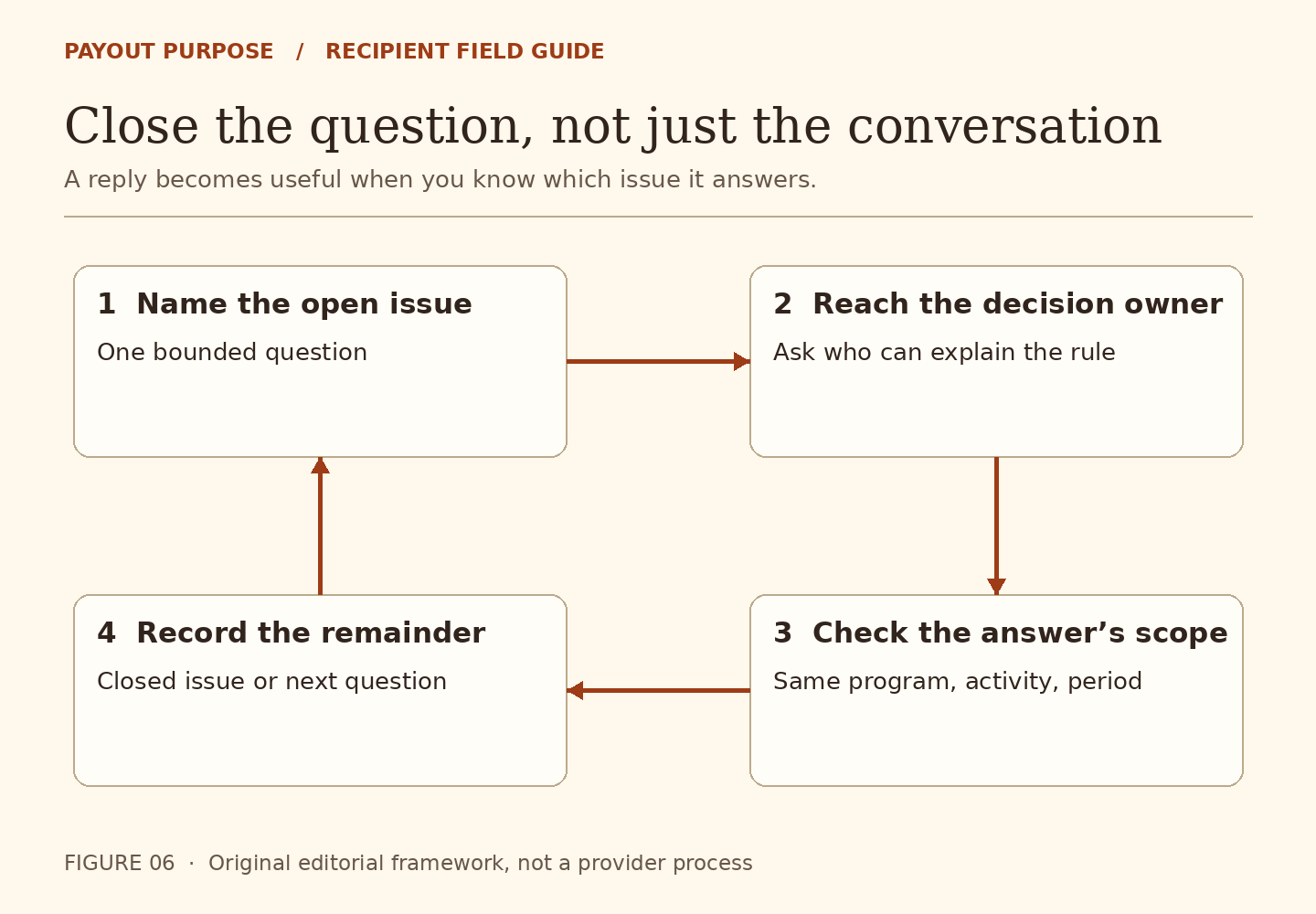
Restate the question you set out to answer
Before reviewing the response, write the original question in one sentence. Examples include whether a payout covers two event days, whether a replacement purchase needs review, or whether an incentive condition was met. If the original message contained several questions, separate them. This prevents a strong answer to the easiest part from obscuring a missing answer to the part that matters for your next step.
Then identify the decision you need to make after receiving the explanation. You might need to submit a permitted record, correct an event description or simply update your understanding of what the payout covers. Do not invent a recipient action when the question only needs an explanation. Sometimes the useful outcome is a clear statement that no further program step is required for the issue you raised.
Apply a four-part closure test
The first part is scope: does the response concern your event, submission and period? The second is substance: does it answer the actual condition or calculation being questioned? The third is authority: does the answer come from the organization or person responsible for that decision? The fourth is consequence: does it say whether anything remains for you or someone else to do? These are reading questions, not a demand that every program issue a formal decision letter.
A short reply can pass all four parts. A long message can fail them if it repeats general information. If one part is missing, follow up on that part alone. You do not need to resend every attachment or restart the entire story. Quote or summarize the precise unresolved point and ask who can answer it if the current recipient cannot.
A fictional example: the unanswered second day
Imagine that recipient Ana asks a fictional event sponsor whether a two-day allowance includes a shortened second day and whether the hosted lunch changes the first day’s treatment. The sponsor replies with a clear explanation of the hosted lunch but says nothing about the shortened day. Ana can mark the first-day question answered while leaving the second-day question open. A single “resolved” label for the whole conversation would hide the remaining decision.
Her follow-up could say: “Thank you for clarifying the hosted lunch. My remaining question is whether the shortened second day is included under the event allowance instructions. Could you confirm that treatment or identify who can?” This preserves the progress already made and gives the owner a bounded task. If the response then explains the second day and says no recipient action is needed, Ana can record the explanation and close that particular question.
Separate understanding from agreement
A complete explanation may still be one you disagree with. Record the decision accurately before deciding what to ask next. If you want to challenge it, ask whether the program provides a review process, what issue it can consider and what information is relevant. Do not call a disagreement a missing answer when the answer is clear, and do not label a case accepted merely because you stopped asking questions.
If a review route exists, treat it as a distinct next step with its own stated requirements. Do not assume a review will change the outcome or that submitting a question suspends a deadline. Ask the responsible organization about any applicable timing, especially when a condition requires prompt action. This article cannot determine rights, calculate legal deadlines or promise a particular escalation option.
Give an unresolved question a real owner
When an answer is still pending, keep the unresolved sentence, the organization responsible and the last substantive response together. If the owner provides a next-update date, record that date as its statement. If it provides none, ask what follow-up method is appropriate for the issue. Avoid turning your preferred timing into a promise from the organization or treating silence as acceptance of your interpretation.
For questions involving several parties, identify the dependency explicitly. For example: “The program owner has explained eligibility but needs one specified account fact before explaining the amount.” That is more useful than “waiting on support.” Share only the information needed to satisfy the dependency through an authorized route. The unresolved condition does not justify sending credentials or unrelated records to every party involved.
Keep a closure record that answers a future reader
A practical closure record states the question, the explanation, its source and date, and any completed or remaining recipient step. It can be brief. If the answer supersedes an earlier explanation, identify the change instead of silently replacing history. If a separate issue remains, name it separately so closing one question does not imply that every aspect of the payout has been settled.
The result should let you explain what was learned without reopening a long thread. Closure here means the educational question has a clear disposition; it is not a legal release, an account reconciliation or a guarantee of payment. The fictional examples and four-part test are original editorial tools. Apply them to your actual program materials without assuming Corpay Prepaid or any sponsor follows a single universal process.