In this article
A receipt can exist without the right person having it, and the person holding it may not be the person expected to submit the expense. These small coordination gaps become confusing when an event payout covers purchases made by several people. A useful remedy is to map the responsibility for each record before making assumptions about who can claim an expense. Here, ownership means responsibility for a practical task, not a conclusion about legal ownership of the money or goods.
Separate four roles around one purchase
For each relevant expense, identify the purchaser, evidence holder, submitter and decision-maker. The purchaser completed the transaction. The evidence holder has the receipt or other accepted record. The submitter is the person instructed to present the expense under the program. The decision-maker determines whether it meets the sponsor’s conditions. One person may fill several roles, but that does not make the distinctions unnecessary. They show exactly where a question should go.
Start with a factual description such as “materials bought for the Saturday workshop.” Avoid putting a full card number, a personal address or unrelated items into a shared note. If someone else bought the materials, ask them what evidence is available and whether it can be shared through the approved route. Do not assume that your participation in the same event authorizes you to obtain their financial records or submit a claim in their name.
A fictional example: one receipt and three participants
At a fictional volunteer workshop, Aisha buys three sets of materials in one transaction. Ben collects the receipt while packing supplies. Chen receives a message asking participants to submit their individual expenses. Without coordination, all three might assume a different person is handling the purchase, or more than one might include the same cost. The useful first step is to identify the actual purchaser and ask the sponsor how a shared purchase should be represented.
Aisha could say: “I paid for three material sets for the workshop. Ben has the receipt. Should I submit the full eligible purchase, or does this program require another allocation?” Ben’s job is to make the permitted evidence available, not to decide eligibility. Chen should not divide the total into three claims merely because three people used the items. The program may have a particular rule, and the group needs that answer before presenting competing interpretations.
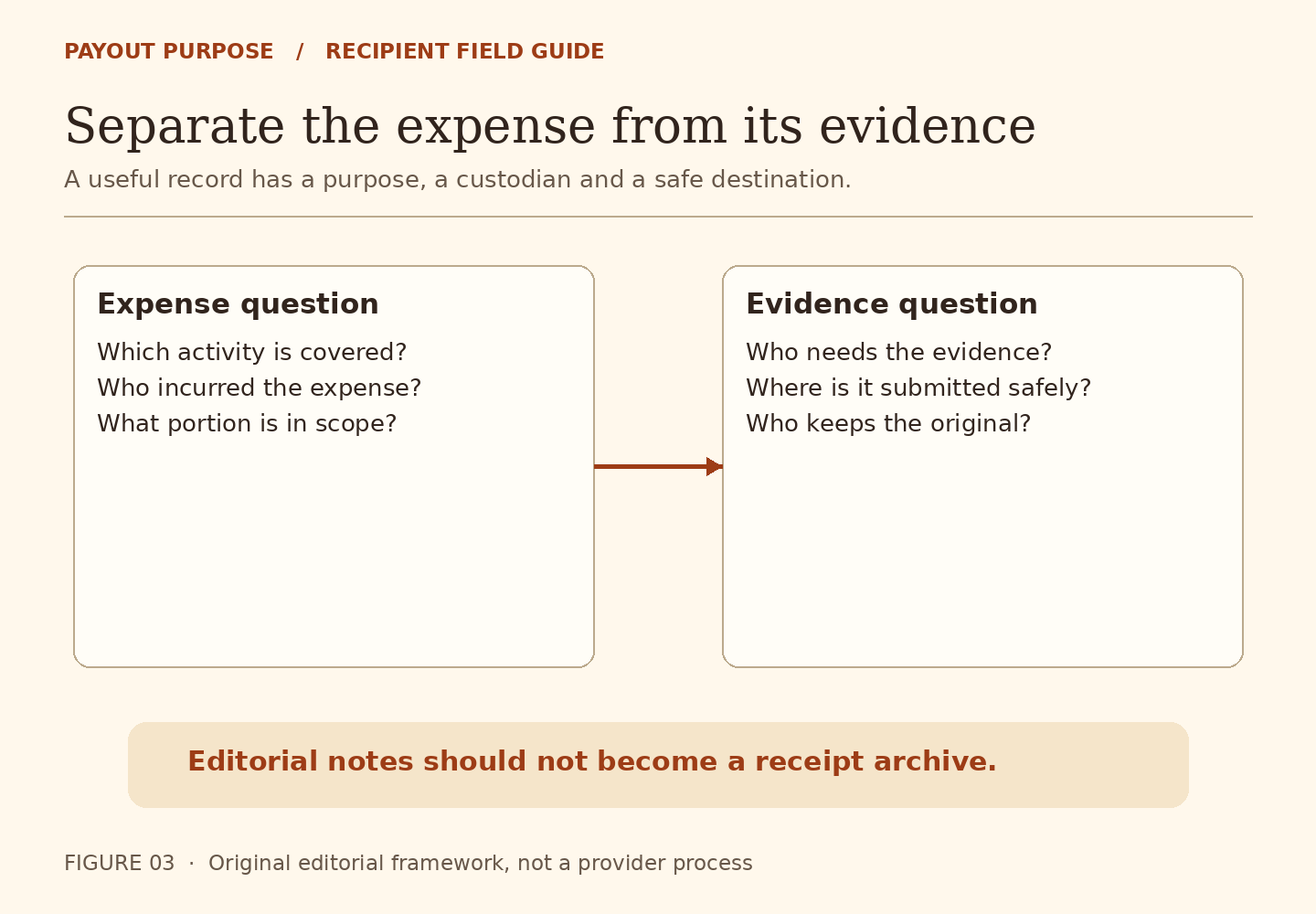
Match the evidence to the question
A receipt often describes items and amounts, while an event instruction explains purpose and eligibility. Those records answer different questions. If the reviewer asks why an item was necessary, a clearer receipt may not help. If the reviewer asks what was purchased, a general approval email may not be enough. Identify the missing fact first, then provide the evidence that actually addresses it using the accepted process.
When one receipt includes unrelated items, ask how the sponsor wants the relevant portion identified. Do not alter the underlying record in a way that misrepresents it. A separate explanation can identify the items being submitted while preserving the original evidence where required. If redaction is appropriate for privacy, confirm which fields the reviewer needs to see and use a permitted method. A recipient-facing education article cannot promise that any particular modified record will be accepted.
Make handoffs explicit
A simple handoff says what record is being provided, which expense it concerns, who will submit it, and whether any task remains. “Here is the receipt” leaves too much unstated when several people are involved. “Here is the workshop materials receipt; Aisha will ask how to submit the shared purchase” assigns the immediate next step without asserting eligibility. Keep the actual record in the authorized channel rather than repeatedly forwarding it through a large group conversation.
Ask whether the evidence needs to be retained and by whom under the program’s instructions. Do not invent a universal retention period or assume that submitting a photo means the original can be discarded. If the sponsor requests a record you cannot obtain, explain the gap promptly and ask which alternatives, if any, it accepts. The absence of a receipt is a fact to address, not a reason to manufacture a replacement or quietly change the expense description.
Resolve overlap before it becomes a conflicting claim
When more than one person believes an expense belongs in their submission, compare the underlying purchase rather than the amounts alone. Similar amounts can describe different purchases, while different amounts can refer to different portions of one receipt. Ask the sponsor to resolve the allocation if its rules are unclear. Avoid informally reimbursing one another as a substitute for understanding the program, especially when that would create another unexplained movement between participants.
The finished record should explain who made the purchase, where the relevant evidence is held, who is responsible for submission and who will decide its treatment. It does not need a shared database of private account details. This is an original method for coordinating expense questions, using a fictional example. It does not establish what Corpay Prepaid can see, which records a particular sponsor requires, or who has a legal right to reimbursement.