In this article
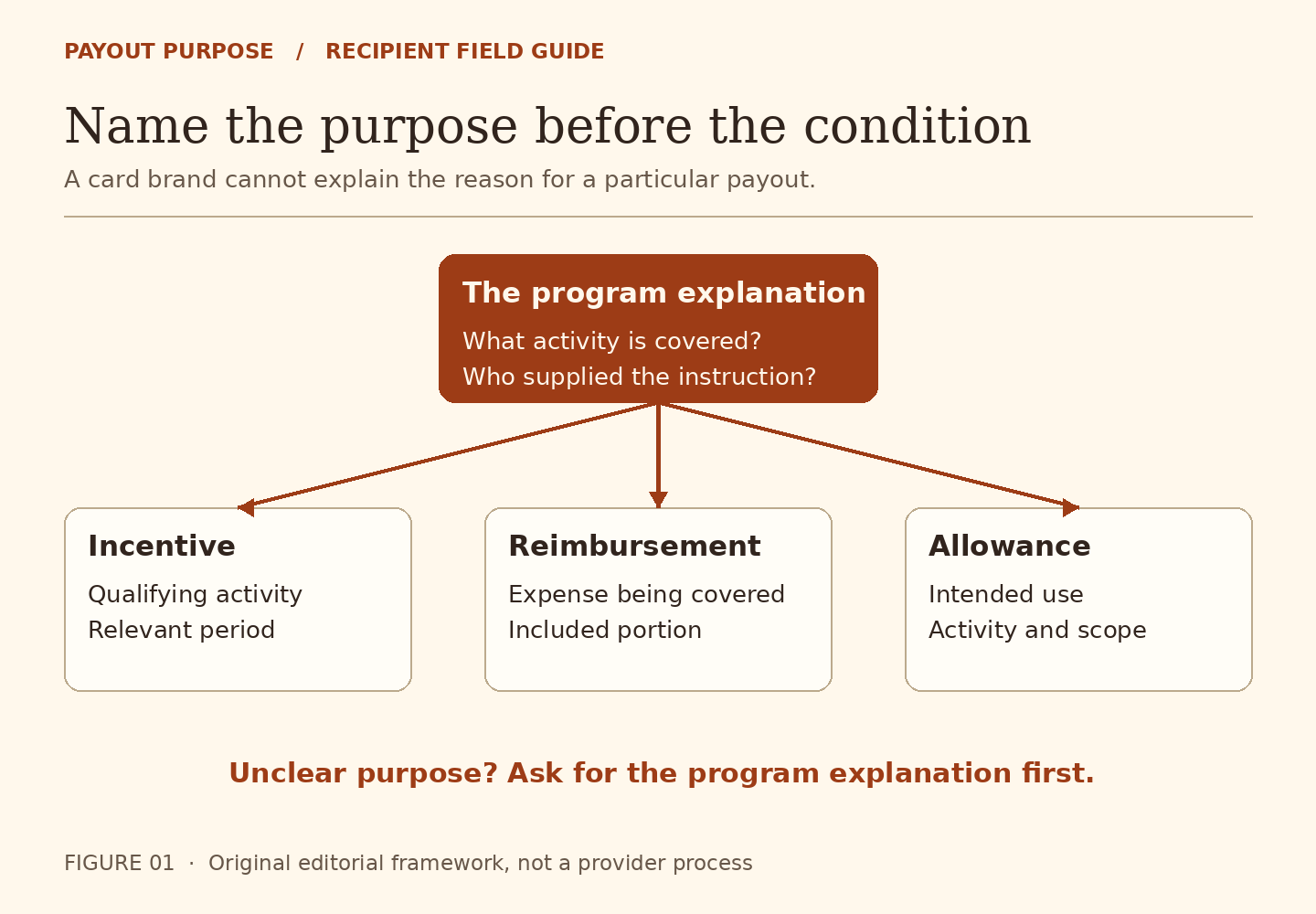
A payout notice can name a card or payment service without explaining what the money represents. That leaves a recipient with the wrong starting question. Instead of asking what people usually do with this kind of card, identify why this particular amount was provided. The answer may connect to an incentive, a previously paid expense, an allowance for a defined activity, or another documented purpose. Similar delivery methods can carry different program conditions, so the payment route alone cannot supply the explanation.
Start with the event that created the payout
Write a plain description of the underlying event before choosing a category. Examples might be completing an optional research session, submitting an approved travel expense, or participating in a three-day training event. Use the description in the notice or your own factual recollection. If you do not recognize the event, mark the purpose as unconfirmed and ask the organization that announced the payout. Avoid filling the gap with the most familiar explanation just because the amount seems plausible.
Corpay’s official FlexCard overview lists incentives, reimbursements, per diem and contractor payments among example uses. That range is useful context: the brand does not identify a recipient’s individual purpose. It is not evidence that every listed use or feature belongs to your program. The relevant explanation must come from the instructions and authorized decision-maker for the payout you actually received.
Build a six-question purpose map
A useful map answers six questions: who provided the payout, what event it relates to, which period it covers, how its amount was determined, what conditions remain, and who can explain a discrepancy. These questions do not require a card number. Start with the organization and event name already visible in your program materials. For the period, distinguish an event date from a submission window. A notice dated in October could relate to an activity completed earlier without making October the covered period.
For the amount, look for the basis rather than inventing a calculation. The basis could be a stated award, selected approved expenses, or a daily allowance under the program’s own rules. For remaining conditions, look for actual instructions concerning documentation, changes to the activity, unused funds or final review. Leave absent answers blank. An empty field makes a good question; a guessed answer can quietly become an assumption you act on.
A fictional example: one event, two explanations
Imagine that Maya attends a supplier workshop. Before the event, she receives a message about a participation award. Separately, the organizer says approved transit expenses can be submitted afterward. A later payout notice mentions only the workshop name. Maya should not conclude that the amount includes both items. Her participation award and transit claim have different reasons and potentially different evidence requirements, even though they share an event and organizer.
Maya’s first question could be: “Does the workshop payout cover the participation award, my submitted transit expense, or both? If it includes both, can you show the allocation?” The answer determines which conditions she needs to read next. If only the award is included, she can keep the transit question open. If both are included, she can record two purpose components under one notice without claiming that the card account separately labels them that way.
Distinguish labels from decisions
Words such as benefit, reward, allowance and reimbursement may be used casually in announcements. Copying a label is not the same as understanding the rule behind it. Ask what qualifies the recipient, whether the amount is fixed or tied to a reviewed expense, and whether anything is expected after receipt. These are practical program questions. They do not by themselves decide tax treatment, employment status, ownership rights or legal obligations, and a card brand cannot settle those issues either.
When materials disagree, preserve the exact statements and their dates. A short announcement might say “travel funds,” while the detailed instructions describe meals only. Do not choose the broader phrase because it is more convenient. Ask which instruction applies to the particular event and recipient group. Request a correction or a clear reference if necessary, so the answer can be understood later without reconstructing an informal conversation.
Finish with one confirmed sentence
The goal is a sentence you can support: “This payout is the stated participation award for the October workshop; the transit submission is being handled separately.” Another result might be: “The purpose remains unconfirmed because the notice does not identify the covered expense.” Both are more useful than an unsupported category. A confirmed purpose makes later questions smaller because you know which instruction set to examine and which event you are discussing.
Revisit the sentence if the sponsor provides a revised breakdown or changes the event arrangements. Preserve the earlier explanation as history rather than blending two versions into one. You do not need an elaborate tracker. You need a reliable description that prevents unrelated conditions from being carried across from one payout to another. This article offers an independent reading method; the examples are fictional and are not promises about any Corpay Prepaid program.