In this article
An invitation to earn an incentive can feel like a promise that the payout is already yours. Often, the useful question is more specific: what does this program say has to happen before a person qualifies? An announcement, a completed activity, a submitted form and a confirmation of qualification are different pieces of evidence. Reading them separately helps you find a missing fact without accusing anyone of an error or assuming that every participant receives the same result.
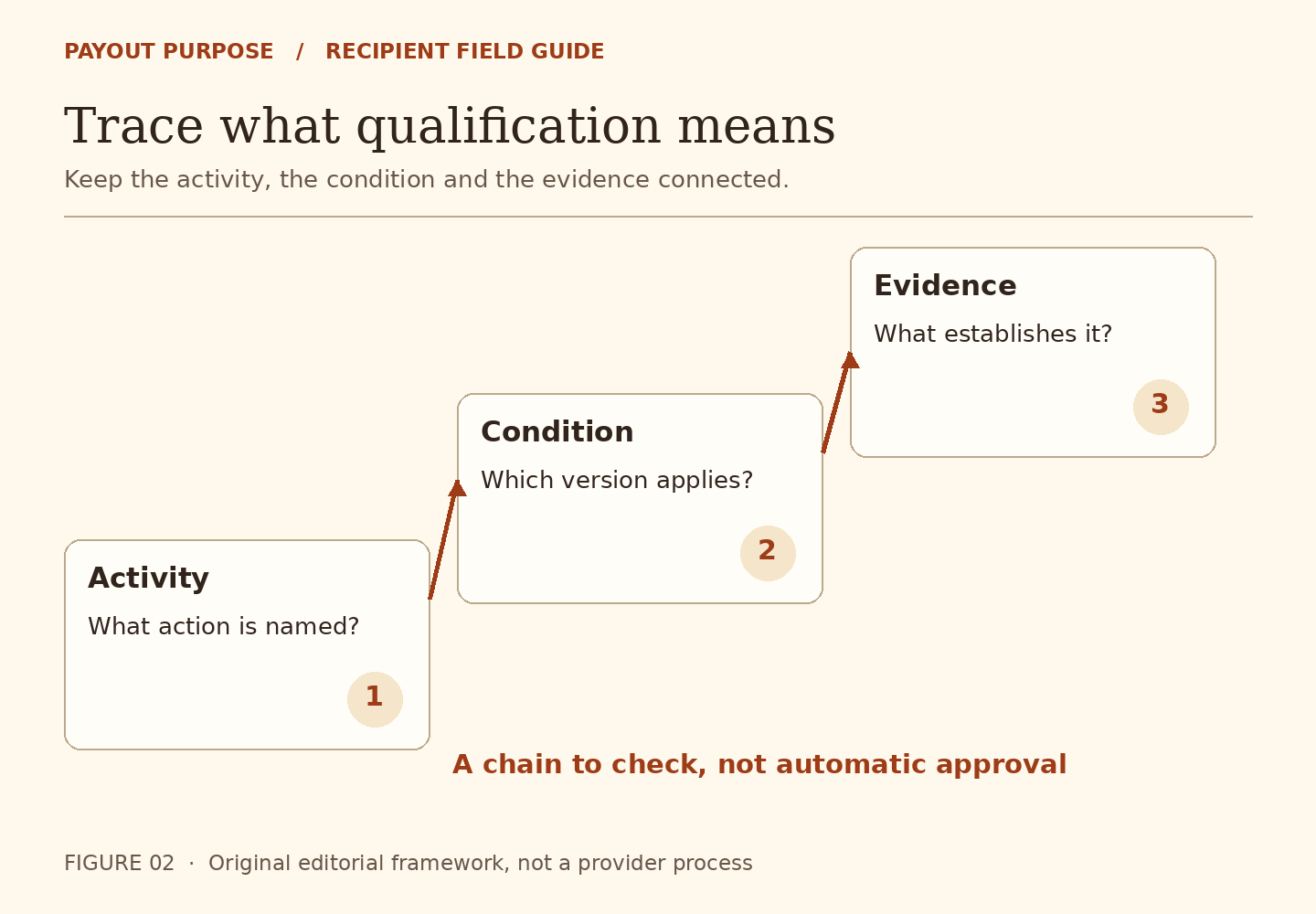
If the notice does not say what the amount represents, identify the payout’s purpose before evaluating its conditions. An incentive question and an expense-repayment question start from different program explanations.
Find the actual qualifying action
Begin with the rule that describes the required action. A promotional headline may name the reward while leaving the conditions in a linked notice. Read the relevant instructions for the event or offer you joined. Look for who can participate, what must be completed, the applicable period, any submission step, and the person or team that confirms qualification. Do not import conditions from a previous campaign even if its title and award amount look similar.
Turn compound wording into separate questions. If a fictional program requires attendance and completion of a feedback form, ask whether both are required and how each is recorded. If an instruction says “selected participants,” ask what selection means for your invitation. If the terms refer to a limit, ask whether it applies per person, event, organization or another unit. These distinctions are more useful than treating the entire message as a single yes-or-no promise.
Keep four links in the chain distinct
A practical qualification chain contains four links: invitation, required action, required evidence and qualification decision. Your invitation supports the fact that you were contacted. Your attendance record may support the fact that you participated. A submission confirmation may support the fact that information reached the stated channel. The final decision answers whether the program regarded the relevant conditions as satisfied. Not every program has four separate documents, but the four questions still help you read what you have.
Do not demand evidence that the actual program never required. The purpose of the chain is to expose ambiguity, not to add paperwork. Where one official message confirms several links, record that clearly. Where a required action is disputed, describe the action and date rather than asserting that a separate confirmation must exist. Your question should invite the decision-maker to explain the applicable requirement and its recorded outcome.
A fictional example: two completed steps and one uncertainty
Consider a fictional skills workshop that offers an incentive to invited participants who attend the full session and submit a short evaluation by the stated deadline. Luis keeps his invitation and the email acknowledging his evaluation. He leaves early for an unavoidable appointment. A later message says his participation is under review. It would be inaccurate for him to say that the evaluation acknowledgement proves qualification, because the attendance condition remains a separate question.
A focused inquiry would say: “I attended the workshop until 3:20 and received acknowledgement of my evaluation. The instructions refer to full-session attendance. Does the program provide a way to assess an early departure, and who makes that decision?” This describes the facts without inventing an exception or hiding the departure. If the sponsor confirms there is no exception, Luis can distinguish disagreement with the condition from a claim that the submission was lost.
Ask about changes without assuming retroactive rules
If a condition seems to have changed, identify the exact versions you saw. State when you received each and which action you took in between. Ask which version governs your participation and whether the sponsor has issued a clarification. Do not turn a later informal comment into a universal amendment. Equally, do not assume an earlier screenshot answers every question if it omitted a linked condition that was part of the original instructions.
Some uncertainty comes from language rather than changing policy. “Complete the session” might refer to attendance, an assessment or both. Ask the owner to explain the phrase in terms of the required action. A useful answer can be checked against what happened. “You should be fine” is less helpful than a statement identifying the condition, the evidence considered and whether anything remains for you to provide.
Keep the inquiry proportional
Provide the event name, relevant dates and the narrow fact being questioned. Use an approved private channel if the sponsor needs participation records containing personal details. Do not send a full card image, login information or unrelated documents to establish that you attended an event. If a record contains other participants’ information, ask for an appropriate way to supply your part rather than forwarding the whole list.
At the end, aim to know whether qualification is confirmed, not confirmed, or awaiting a specified review. A clear unresolved status includes the actual question and who is addressing it; it is not a prediction of when money will arrive. This independent method does not determine entitlement, legal rights or tax treatment. It helps you discuss the program’s own conditions precisely, using fictional examples rather than assuming the same incentive rules apply across all Corpay Prepaid arrangements.