In this article
Returning an item can solve a shopping problem while leaving a program question unanswered. A merchant handles the purchase return under its process. The organization that provided a related payout may separately need to explain how the changed expense affects the program’s records or conditions. These are connected events, but one does not automatically complete the other. Keep the questions separate so that neither a merchant conversation nor a program message is treated as evidence of a decision it did not make.
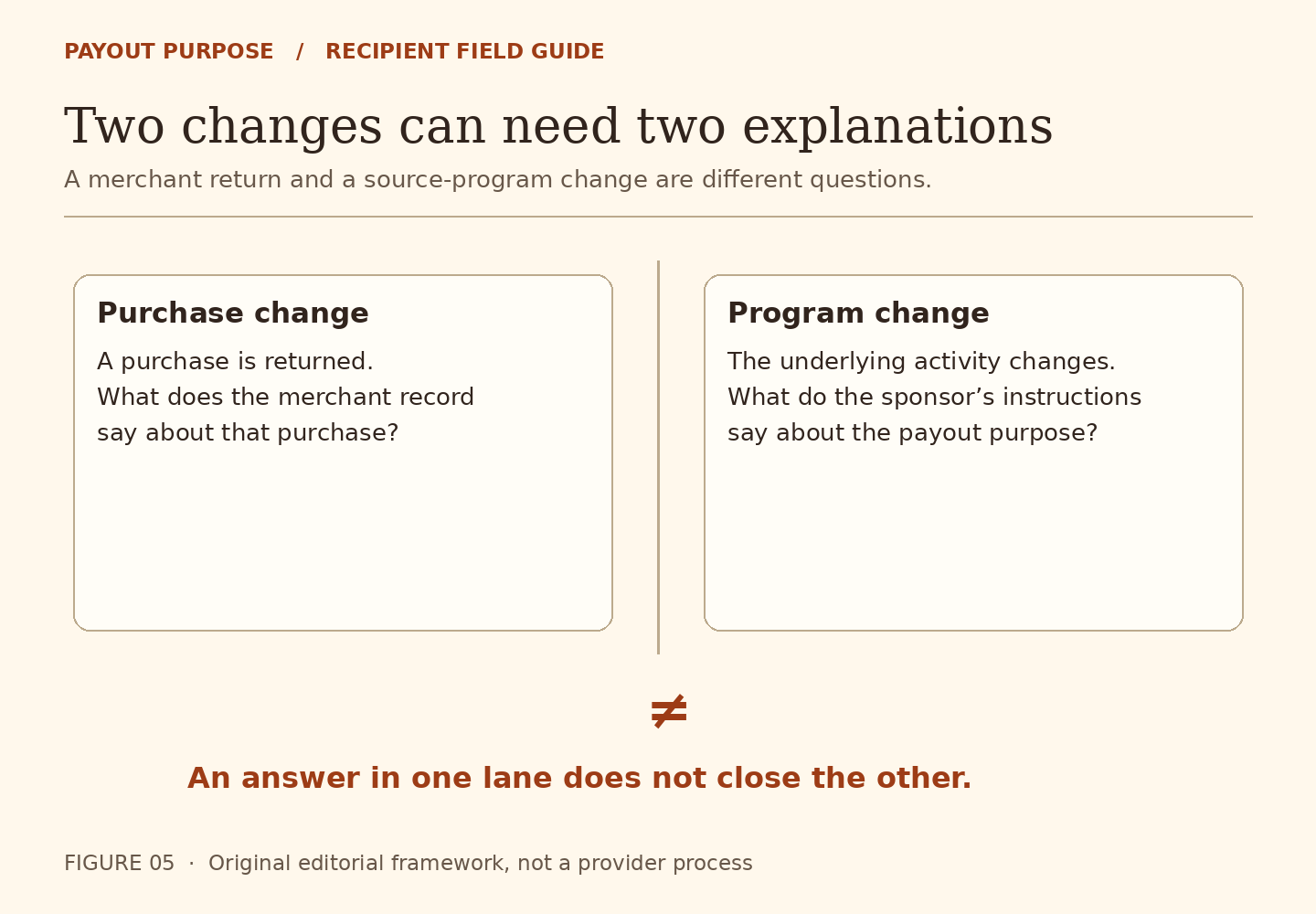
Name the two changes without merging them
The first change concerns the purchase: what item was returned, exchanged or canceled, and what evidence records that action. The second concerns the payout’s purpose: whether the original expense still supports the program’s calculation, whether a replacement expense needs review, or whether an earlier explanation must be revised. This article addresses the second question. It does not diagnose card transaction states, promise refund timing or explain a dispute process.
Begin by identifying the relationship between the purchase and the payout. Was the payout described as repayment of that specific item, upfront funds for a defined activity, or an award unrelated to the item? If it was unrelated, a purchase return may have no program consequence at all, but you should not invent that conclusion when the instructions tie the money to an expense. Use the documented purpose to decide which question needs an answer.
A fictional example: an unsuitable projector
Consider a fictional community-event program that repays approved equipment expenses. Omar receives a payout connected to a projector purchase. The projector proves unsuitable and he returns it, then buys a different model. He has changed both the original expense and the evidence for the eventual equipment used. Sending only the replacement receipt without mentioning the original return could leave the reviewer with an incomplete picture.
Omar’s question can be factual: “The projector covered by my approved submission was returned, and I purchased a replacement. How should I update the program record, and does the replacement require a new review?” He should identify the two purchases through the program’s permitted references. He should not assume that matching prices make the replacement automatically acceptable, or that a higher price is automatically covered. The sponsor must explain the applicable conditions.
Now change the example. Suppose Omar’s original payout was a fixed participation award, with no condition tying it to equipment. The projector purchase would have a different relationship to the program. That difference illustrates why understanding purpose comes before deciding what a return means. It does not establish that all awards are unrestricted or that every reimbursement program has the same adjustment rules.
Do not substitute an improvised correction
Recipients sometimes try to make a record “come out right” by leaving a future expense unclaimed, reducing another submission or transferring an estimated amount. Such actions can create new uncertainty about which event was corrected. Ask for the official procedure instead. If the sponsor says an adjustment is needed, ask which original payout it concerns, how the amount was determined and what recipient action is required through a verified channel.
A message that identifies an adjustment is not a reason to send funds to an unfamiliar destination. Verify any instruction against the program’s established process and seek clarification when the action or recipient is unexpected. Do not share credentials or full card details to explain an expense change. The ordinary purpose question can usually begin with the event, the expense description and the relevant dates rather than sensitive account information.
Account for partial returns and shared purchases carefully
If only part of a purchase was returned, distinguish the returned portion from the items still used for the activity. A receipt total alone may not show that distinction. Describe the items and ask how the sponsor wants the revised expense represented. If the purchase served several participants, identify who is responsible for updating the original submission so the same return is not reported as several independent corrections.
An exchange can also change the program question without producing a simple “money back” story. The replacement might be a different category, used on a different date or no longer needed for the approved activity. Explain those changes rather than presenting the event solely as arithmetic. Eligibility can depend on the program’s purpose and conditions, so an equal-price exchange does not necessarily answer the reviewer’s substantive question.
Close both questions on their own evidence
Keep the merchant’s confirmation of the return with the purchase record. Separately, keep the program’s explanation of how it treated the changed expense. You have understood the program consequence when the sponsor identifies the applicable treatment and any remaining step, or confirms that no program change is required. A generic acknowledgement of your message may not answer either point.
This approach is deliberately narrow: it helps a recipient communicate a changed expense accurately. It does not authorize a return, establish repayment obligations, recommend withholding money or guarantee that a provider can reverse a payout. The examples are fictional. For an actual Corpay Prepaid-related program, rely on the relevant sponsor instructions and authoritative account information for their separate subjects.